
Category: Uncategorized

  • How to Take Better Notes While Reading (and Actually Remember What You Read)

    How to Take Better Notes While Reading (and Actually Remember What You Read)

    Taking notes while reading isn’t just something students do — it’s one of the most powerful ways to understand, retain, and use what you read. Whether you’re reading textbooks, research papers, or articles, effective note-taking turns passive reading into active learning. Studley+1

    Let’s walk through why it matters and how you can do it in a smart, sustainable way so your notes actually help you learn — not just collect dust on a page.


    1. Why Note-Taking Matters More Than You Think

    When you take notes as you read, you’re doing more than writing words — you’re interacting with the material. That process helps:

    • Deepen comprehension: You’re forced to think about what the author is saying and why it’s important. OpenStax Assets
    • Improve retention: Notes help you remember key ideas later because you’ve processed them actively. University of Reading LibGuides
    • Build a study resource: Instead of rereading entire pages, you can review your structured notes. The Learning Center

    In other words, note-taking transforms reading from a passive act into an active one.


    2. Before You Start Reading: Get Ready

    Skim first.
    Take a few minutes to preview the structure — table of contents, chapter headings, summaries — so you know what’s coming. This gives your brain a roadmap and makes note-taking more strategic. Wikipedia

    Think about your purpose.
    Are you reading for understanding? For research? For an upcoming test? Your strategy should depend on your goal. For example:

    • If you’re studying for a test, focus on concepts + examples.
    • If you’re reading for research, focus on arguments + evidence.

    3. Active Reading + Annotation Techniques

    Instead of highlighting everything (we all fall into that trap), try these active strategies: The Learning Center

    Highlight selectively

    Only mark what’s truly important, not every sentence that looks “useful.” Otherwise, nothing stands out. Medium

    Annotate as you go

    Write short notes in the margin or in your notebook about:

    • Main ideas
    • Questions that come up
    • Surprising facts

    This turns reading into a dialogue with the text. Studley

    Use symbols and shorthand

    Develop a quick shorthand system — like:

    • “!” for key insights
    • “?” for confusing parts
    • “→” for cause/effect
      This speeds up your note-taking and keeps pages clean. unsw.edu.au

    4. Note-Taking Frameworks That Work

    Here are a few structured ways to take notes that help your brain organize information:

    🧠 Cornell Method

    Divide your page into:

    • Notes section
    • Keywords/question column
    • Summary at the bottom

    This forces you to condense and reflect on what you read. Wikipedia

    🌀 Outline Method

    Use headings, subheadings, and bullet lists to break down ideas hierarchically. Great for dense textbooks. GoodNotes

    🌳 Mind Mapping

    Draw a visual map connecting concepts — excellent for visual thinkers. www.slideshare.net

    You don’t have to stick with one forever; mix methods until you find what clicks for you.


    5. At the End of a Section: Summarize

    After each chapter or major section, take a moment to write a short summary in your own words. This helps you:

    • Consolidate learning
    • Spot gaps in your understanding
    • Prepare better for review later

    Studies show that summarizing improves retention because it forces you to distill ideas into their essence. Reading Rockets


    6. Review Your Notes Regularly

    Don’t just take notes and forget them! Regular review — even briefly once a week — boosts long-term memory and understanding. It turns short-term recognition into deep mastery. unsw.edu.au


    7. Turn Notes Into Useful Study Tools

    Once you’ve taken notes, you can transform them into:

    • Flashcards for spaced repetition
    • Concept maps for review
    • Quizzes for self-testing

    This turns passive notes into active learning tools — one of the key study strategies used by top students. Studley


    Your Reading, But Smarter

    Great reading is a skill — and note-taking makes it intentional. Instead of letting information fly by, you slow it down long enough to understand, connect, and remember it.

    Whether you’re prepping for exams, doing research, or just reading to learn, mastering note-taking will boost your comprehension and make your study time much more effective.

    Want tools to make this even easier? Try Kardly.ai — where smart workflows and AI-assisted study tools help you turn notes into knowledge. 📚✨
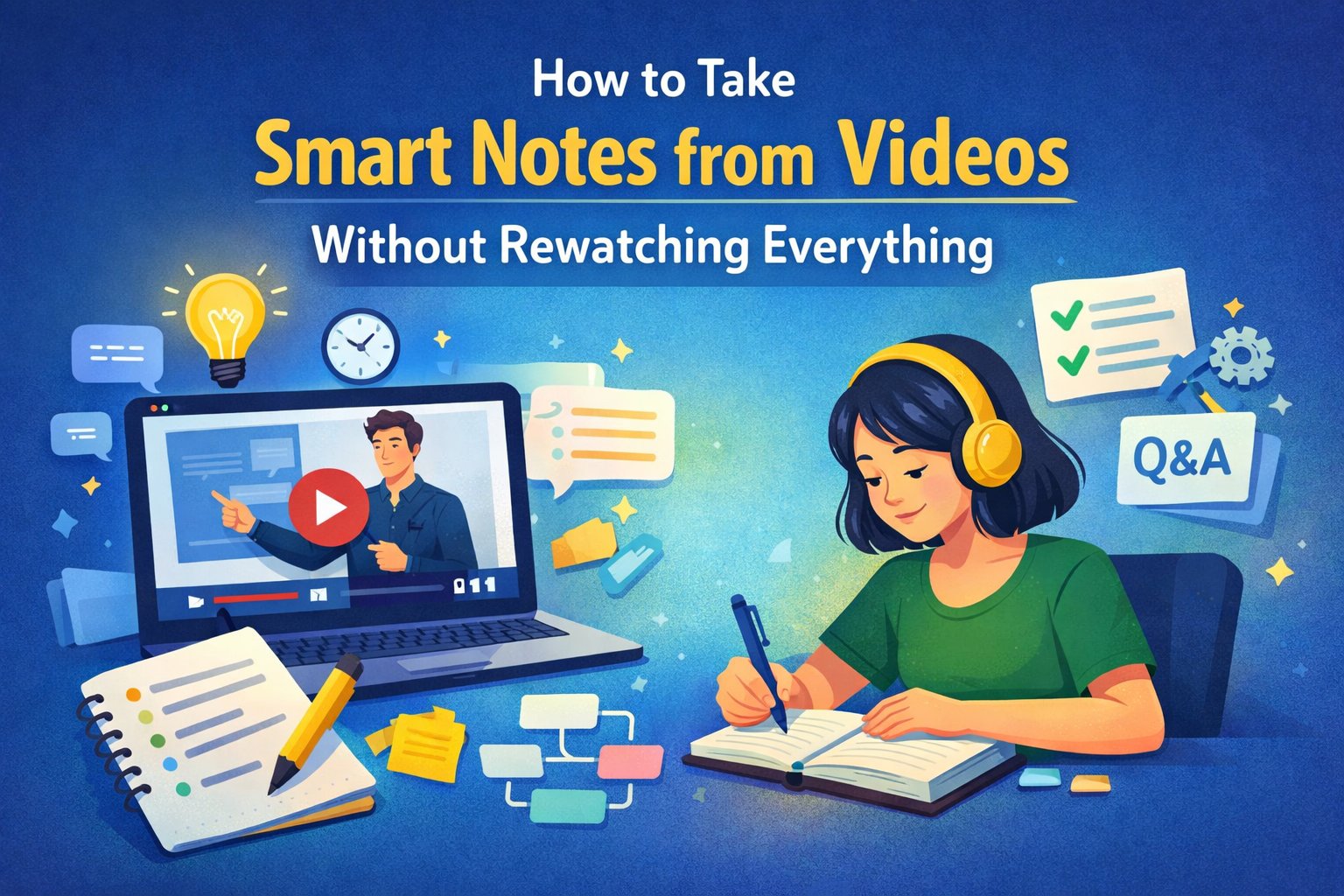
  • Why Video Note-Taking Is Different

    Why Video Note-Taking Is Different

    Unlike textbooks or articles, videos move forward whether you’re ready or not. You can’t skim easily, and important ideas can be missed if you lose focus for just a few seconds.

    That’s why good video note-taking requires:

    • Active attention
    • Clear structure
    • Smart use of tools

    Once you adjust your approach, videos become one of the most powerful learning formats available.

    Step 1: Define Your Purpose Before Watching

    Before pressing play, ask yourself one simple question:

    “What do I want to learn from this video?”

    Write down:

    • The topic or title
    • Why you’re watching it
    • What you expect to gain (key concepts, exam prep, skill practice, etc.)

    This creates a mental filter so you focus only on information that matters — instead of trying to capture everything.


    Step 2: Break the Video into Sections

    Instead of treating the video as one long piece of content, divide it into parts.

    You can:

    • Use visible chapter markers (if available)
    • Create your own sections based on topic changes
    • Add timestamps next to your notes

    This makes your notes easier to review later and helps you quickly return to specific moments without rewatching the entire video.


    Step 3: Listen for Ideas, Not Sentences

    One of the most common mistakes learners make is trying to write down exactly what the speaker says.

    Instead:

    • Focus on ideas and explanations
    • Write short phrases or bullet points
    • Use your own words whenever possible

    If you can explain the concept in your own language, you’re already learning — not just copying.


    Step 4: Pause Strategically (Not Constantly)

    Pausing is useful, but overusing it breaks your focus.

    A better approach:

    • Watch a short segment (1–3 minutes)
    • Pause and write down key points
    • Resume without immediately replaying

    If something is unclear, then rewind. This keeps your attention on understanding rather than perfection.


    Step 5: Use Visual Signals in Your Notes

    Your notes should be easy to scan later.

    Try using:

    • Bold text for main ideas
    • Symbols like ⭐ for important concepts
    • Indentation for supporting details
    • Simple diagrams for processes or comparisons

    Visual organization saves time when reviewing and helps your brain recall information faster.


    Step 6: Summarize After the Video Ends

    The most powerful learning happens after the video.

    When you finish watching:

    • Write a short summary (3–5 lines)
    • List key takeaways
    • Note any questions you still have

    This step strengthens memory and reveals gaps in understanding while the content is still fresh.


    Step 7: Turn Notes into Study-Ready Material

    Raw notes are useful, but structured notes are even better.

    You can:

    • Convert key points into flashcards
    • Create a checklist or outline
    • Group related ideas together

    This makes your notes reusable — especially for revision, exams, or future projects.


    How Kardly.ai Makes Video Learning Easier

    Manual note-taking is effective, but it can also be time-consuming. Kardly.ai helps by transforming video content into:

    • Clear summaries
    • Structured notes
    • Flashcards you can review anytime

    Instead of rewatching videos repeatedly, you can focus on understanding and retention — faster and more efficiently.


    Final Thoughts

    Taking notes from videos doesn’t have to feel chaotic or exhausting. With the right strategy, you can turn any video into organized, meaningful knowledge that sticks.

    Focus on purpose, structure, and clarity — and let your notes work for you, not against you.

    Ready to learn smarter? Kardly.ai is built to help you do exactly that.